The Living Desktop is a custom interactive desktop environment that replaces a static wallpaper with a live, clickable scene — a row of retro arcade cabinets running real gameplay. It started as a Matrix-style wallpaper with a Spotify lyrics overlay and evolved, version by version, into a working arcade: click a cabinet's coin slot and a Sega Genesis emulator boots a real, fully playable game right on the desktop. ChatGPT generated the cabinet artwork, Claude Code wrote the Python that embeds the video players, wires the audio, and integrates the emulator, and Python holds the whole scene together as one live desktop layer.
PythonClaude CodeChatGPTEmulationInteractive Desktop
Autonomous Content Agents — Vibe & Sage
Two AI agents that independently produce and publish video content, end to end.
Vibe and Sage are autonomous agents in my local AI ecosystem, each running a complete content pipeline with almost no human touch. Vibe builds lo-fi music videos: it takes a set of tracks, stitches them into a 20–45 minute video, generates the cover artwork, then writes the title and description and publishes straight to YouTube — the only manual step is pulling the source tracks from Suno, which has no API. Sage is fully autonomous end to end: it researches a Greek mythology figure, writes the script, narrates it through ElevenLabs, generates artwork with Higgsfield, assembles the finished video, and — after a single human review gate — publishes it to YouTube itself. Each agent orchestrates several AI services into one self-running production line, and both channels are live and publishing now.
AI AgentsAutomationOrchestrationElevenLabsHiggsfieldYouTube APIPython
Read the full writeup →Steam TV Wall is a live launcher dashboard disguised as a wall of vintage CRT televisions, each screen looping a real trailer pulled from a game in my Steam library. What started as a static room of black TVs grew, version by version, into a full control-room interface: click a screen to select a game and its trailer fades up in sync with the picture, filter the wall by genre or play-status, search and sort the library, and double-click to launch the game straight into Steam. It reads everything live from local Steam files — installed state, playtime, last-played, even install size — with no API or login, and frames the grid with real CPU/GPU temperatures, weather, storage, and a recent-activity feed. ChatGPT generated the room artwork; Claude Code wrote the Python/Pygame engine that decodes twenty video tiles at once, parses Steam's VDF config files, and draws the entire flat-UI dashboard frame by frame.
PythonPygameClaude CodeSteamInteractive Desktop
Praetor — Personal AI OS & Code Factory
An AI operating system whose code factory turns phone-captured ideas into built, adversarially-reviewed branches — and I merge every one.
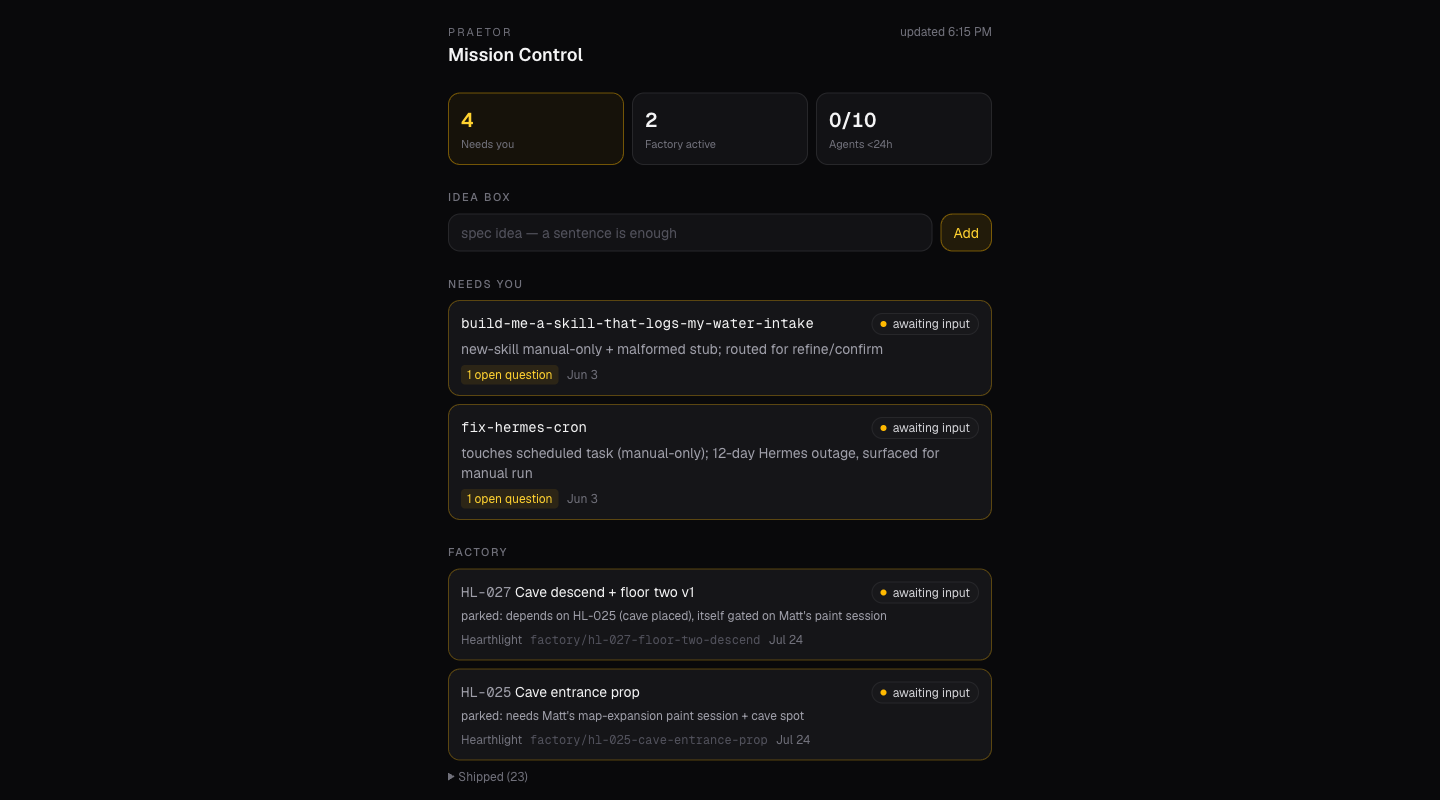
Praetor is the personal AI operating system that runs my day — morning briefs, content pipelines, and its centerpiece, a code factory. An idea captured from my phone becomes a builder-ready spec through a short interview; a queue arms the day's packet; an autonomous Claude Code agent claims each spec, builds it on its own git branch, and has to pass a deterministic verification harness before facing adversarial review — eight independent reviewer agents hunting for real bugs, whose findings are verified against the running game engine before they count. Twenty-plus specs have shipped into a Godot game in active development this way, including must-fix bugs the review caught before I ever saw the code. The guardrails are the point: branch-only, trust-laddered, production repos spec-only, and a human — me — merges every line. Mission Control, above, is its gated live dashboard: Next.js and Supabase on Vercel, with idea capture, queue state, and agent heartbeats.
AI AgentsClaude CodeMulti-Agent ReviewNext.jsSupabaseVercel
TLDR turns a wall of text into the gist, at a length you control. Paste raw text or a web page URL, drag a slider from 1 to 10 sentences, and get a clean summary you can copy or download — no account needed. It's built on Next.js with all AI calls running server-side through Claude Haiku, and pages are fetched and stripped to readable text with Mozilla Readability before summarizing. Because it's a public tool hitting a paid API, it ships with real guardrails: a hard input cap, per-IP rate limiting, and a conservative token budget so it can run unattended without a runaway bill.
Next.jsClaude HaikuAnthropic APIVercel
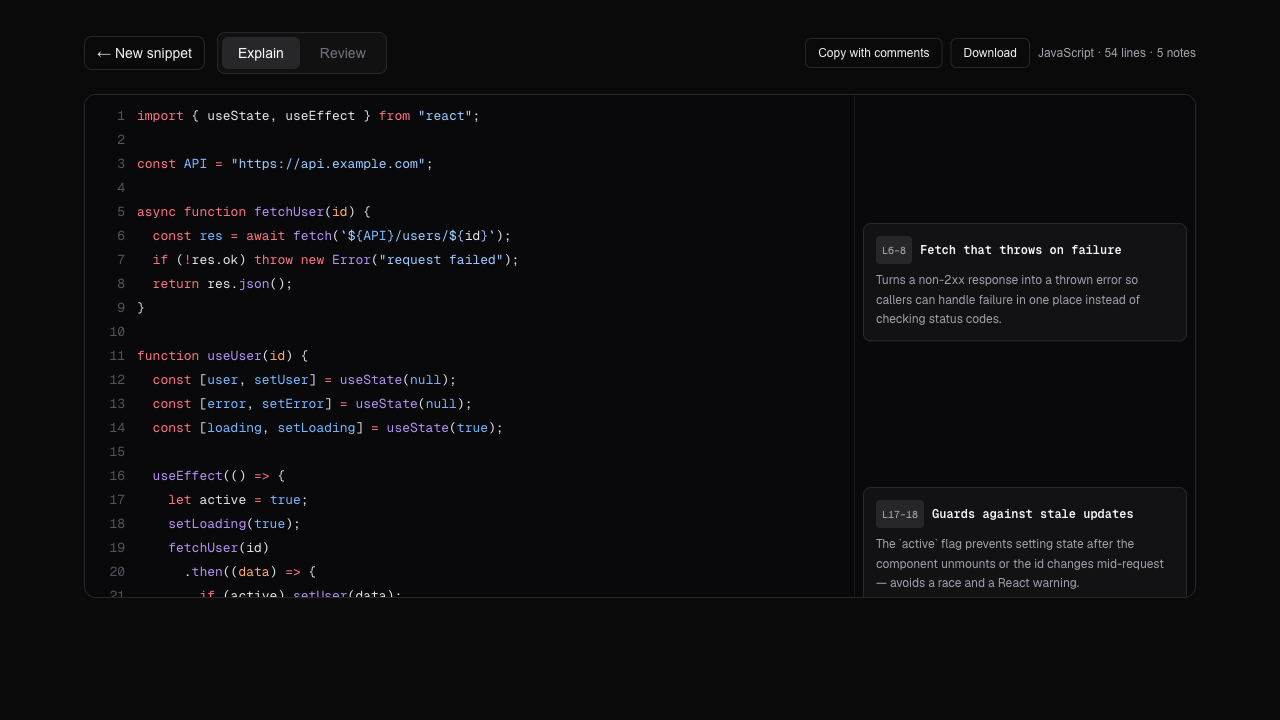
AI made words-into-code effortless, but left no good reverse path — people now ship code they can't read. The Code Explainer fixes that by putting the explanation next to the line it describes: your code stays untouched on the left, plain-language margin notes sit beside the relevant lines on the right. A depth toggle switches between Explain (what the code does and why) and Review (risks, smells, edge cases), and it annotates only the load-bearing logic — three sharp notes, not twelve noisy ones. You can export the snippet with the notes injected as inline comments in the right syntax. Built on Next.js with Claude Haiku server-side, language auto-detection, and the same cost/abuse guardrails as the Summarizer.
Next.jsClaude HaikuDeveloper ToolsAnthropic API
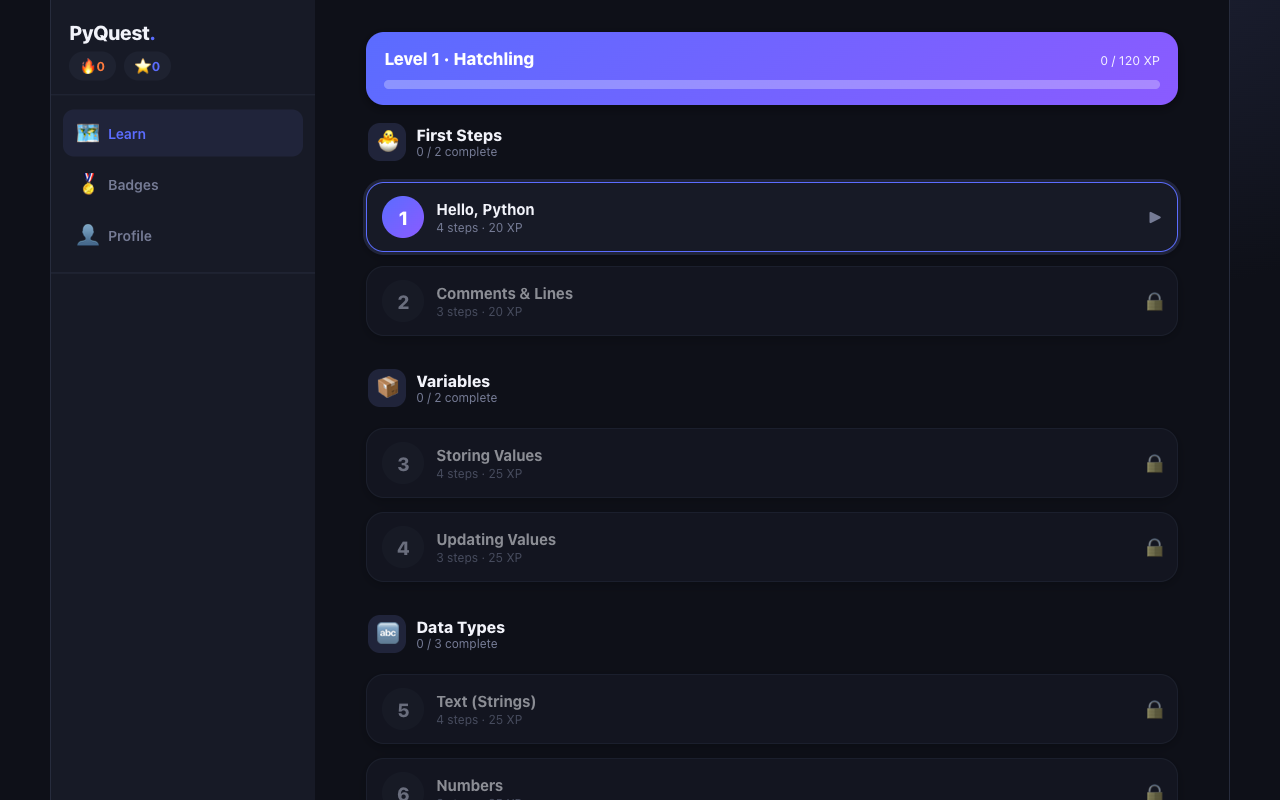
PyQuest is a Mimo-style app for learning Python through short, gamified lessons, with real Python executing in the browser via Pyodide. Ten units and ~28 lessons cover the beginner foundations across five exercise types, including write-and-run code challenges that auto-check your work. XP, levels, daily streaks, and achievement badges keep it sticky; the lessons live in a plain text file you own and can edit. It runs CPython compiled to WebAssembly inside a Web Worker (with a timeout guard so runaway loops can't freeze the UI), ships as a static PWA you can install to your phone, and works offline after first load — no backend, no accounts.
PythonPyodideWebAssemblyPWAWeb App
EDITH — Voice Assistant
In progressA JARVIS-lineage voice assistant with real system agency — voice-first, with its own visual identity.
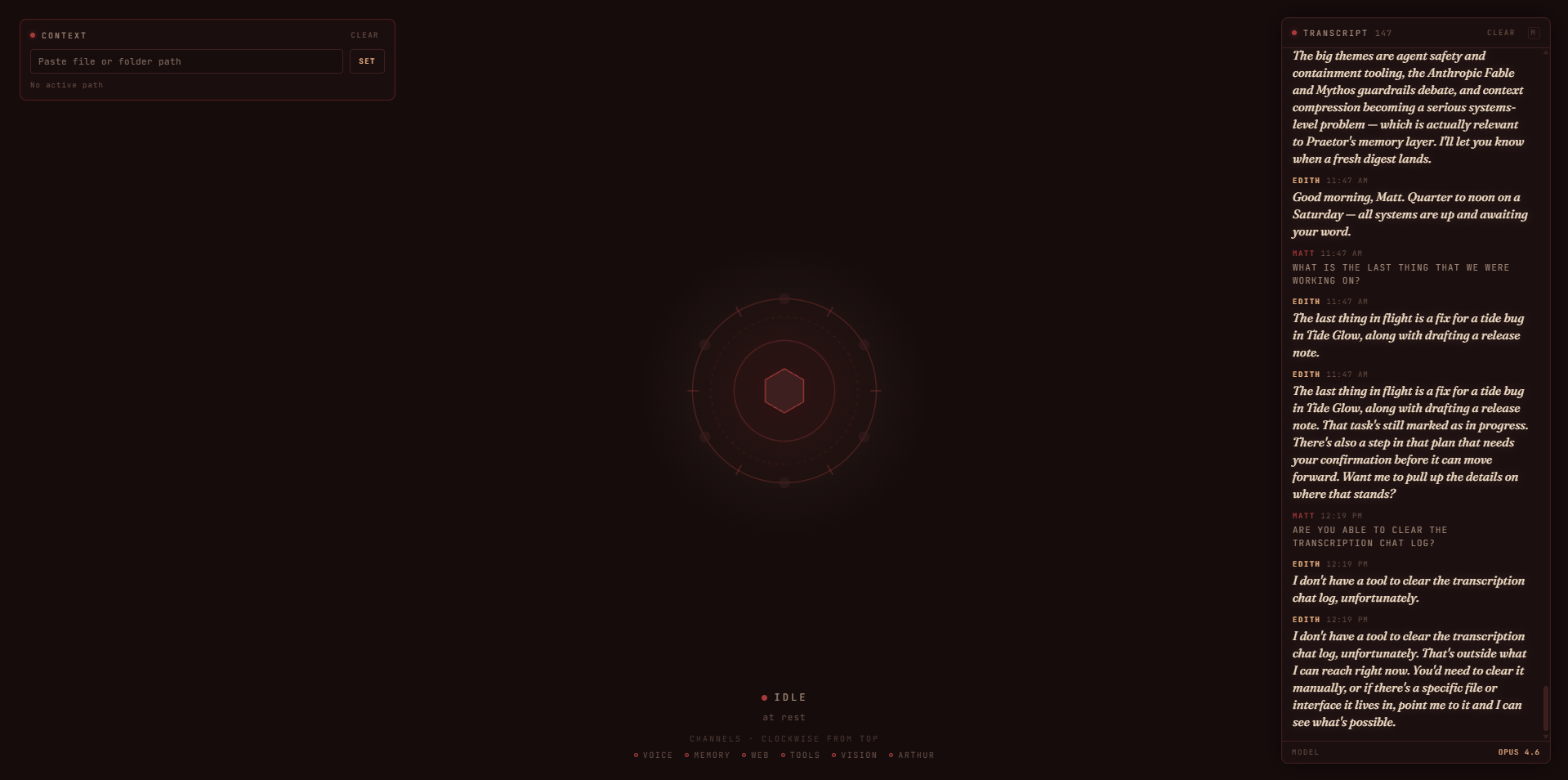
EDITH is a voice-first AI assistant built to be a genuine working partner, not another chat window — the JARVIS-to-Tony-Stark dynamic. She runs on the desktop with real system agency: shell, screenshots, file access, and browser control by voice, fronted by a custom oxblood-and-bone “aperture” HUD that animates through listening, working, and insight states. The build is phased — from rebranding an existing working program, to a cloud brain on Fly.io, an iPhone client, and long-term memory — targeting sub-2-second voice latency for under $60/month. Deliberately a capable tool, not a companion.
Voice AIClaudePythonElevenLabsFly.io
Tideglow is a cozy underwater life-sim built in GameMaker under the Yardyprince Gaming Co. banner — roughly 90k lines of code and hundreds of hours of design. It blends relaxed fishing-and-farming loops with Zelda-style progression and a darker mystery beneath the surface. Currently in vertical-slice polish: most foundational systems are stable, with content scale-up and late-game beats remaining.
GameMakerGame DevPixel Art
Shining Force II Remix
In progressA Godot 4 remake/remix of the Sega Genesis tactical RPG Shining Force 2.
Demo coming soonLive demo link added once deployed.
A Godot 4 remake and remix of Shining Force 2, the Sega Genesis SRPG: grid-based tactics battles with full-screen “cut-in” attack and spell cutscenes, overworld town and field exploration, and an SF2-style promotion system where each character promotes once along one of two branching paths. Sprites and animations come through a custom AI-assisted art pipeline.
Godot 4Game DevSRPGPixel Art
Demo coming soonLive demo link added once deployed.
Castle is the canonical reference for a multi-agent ecosystem: a set of specialized agents, each with its own PRD, organized as a coherent “realm” rather than one monolith. It defines the boundaries, naming, and responsibilities for how the agents cooperate.
AgentsMulti-AgentArchitecture